welcome back!
today i took my first dive into my topic, namely, “can adaptive algorithms replace traditional instructors?”. now this is a big topic mind you, but with some quick google searches, i was able to come around my first compelling result. now just the abstract alone is enough to draw someone in; it discusses the mimicry that models use to fake empathy, and mentions an interesting new phrase (to me), “digital dementia”, where it describes it as “a decline in memory, concentration, and critical reasoning”. all very fascinating! ill keep it in accordance with the papers sections, but here’s what i got out of it:
1 : introduction
here, we touch back on the topic of “digital dementia”, which is described as “a phenomenon of reduced memory, focus and critical reasoning due to the increasingly frequent delegation of
thought processes to technology“, and how so called “digital natives”, people born after 1980, stand out as the most affected groups. they have an excessive reliance on digital
tools which due to their nature of favoring short superficial interactions, can lead to lower emotional literacy, and in turn, those with less emotional and digital literacy are the most vulnerable.
a foggy line can be drawn, where sometimes the user finds it hard to see the difference in simulated empathy and real empathy.
the term “empathy gap”, originating from Kurian, N., describes how these models, chatbots, etc, ‘fake’ empathy without actually having any, or even the inverse through their sometimes misleading effect on the user. even so, there are cases where users perceive them as friends, or even companions. this brings into question reciprocity; as this relationship is always one-sided. because these ai models are only simulating this, there’s a risk of “emotional manipulation”, and with this, the user must know who or what they are communicating with. even so, this can lead to frequent users struggling with human interaction or the understanding of real emotions.
finally, a quote that i quite like, ” ’empathy among algorithm’ is currently a one-way street”; a user projects empathy, and the algorithm tries to imitate it.
2 : literature review
from my knowledge, mimicry is a source of flattery, and most people, without even knowing it, have this tendency. an example being, if someone’s sad, we, as a spectator, or not, feel a similar way, or adopt the same facial expression or tone. its described as a social ‘glue’, with these matching emotions strengthening trust and empathy.
interestingly enough however, research shows that people tend to show this same flattery with these models. knowingly or not, users apply social norms when interacting with computers, and respond to such social behaviors similarly, human, or ai model. children in particular often perceive chatbots as “quasifriends”, leading them to trust them with their feelings, even though these models don’t have real feelings; yet sometimes ai responses are rated more empathetic than human responses.
beyond socials, there are other effects and tolls that use of these models may have. for one, the “google effect”; although this has been around long before these ai models, its idea stands, when we know information is readily available, we’re less likely to remember it permanently. like google being one click away from the answer, these models do the same. following excessive reliance such a system, an issue of “cognitive dependence” occurs, typically followed by a decrease in independent analytical and critical thinking.
going back to this idea of digital dementia, neurologist manfred spitzer says such patterns lead to impaired memory, poor focus and learning disorders; similar to that of dementia. new research also shows that early exposure to screens can negatively affect the structure and function of the brain.
3 : methodology and results
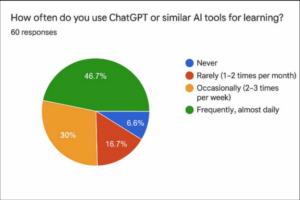
finally, we arrive at study done.it consisted of 60 students of various study programs aged 20–25, done through an anonymous online survey in September 2025. the format shared both closed and open questions. the results are as follows:
- 47% of students use ai almost daily, 30% occasionally, 17% rarely, and only 7% never use it.
- 55% rate ai messages as mechanical and without impact, while 35% admit that they still like them and
find them potentially motivating. - 57% of students stated that at least sometimes
the ai seemed more pleasant or understandable to them than the lecturer; only
27% say they have never felt it. - 47% partly believe phrases
like “I understand that it is difficult for you”, but a third do not believe them
at all, while only a small number perceive them as sincere. - 67% of students think that education about emotional literacy should be introduced in the digital environment, while 22% remain undecided, and 8% think that it is not necessary
 4 : reflection
its quite interesting to read about this stuff when you actually use these models. like i have stated before, i’m no stranger to ai. i’ve used it countless times to help me digest content, be it through generating practice questions, or me just asking for reassurance on every.single.detail. yet, through all my time with using it, have i ever really thought about it emotionally, empathically? well that im not entirely sure of. i most definitely have shown emotion, meaning to or not? ive been short before, being frustrated not understanding something, or being displeased with a response; and maybe, algorithmically, it senses that and tries its best to send that back to me.
right now, however, i can say that i don’t believe it to be a replacement. it has its benefits as a tool; not an instructor.
source: the illusion of understanding: digital empathy and emotional mimicry in ai-driven education